Most institutions evaluate fraud environments through lagging indicators: total losses, fraud rates, chargeback volumes, operational case counts, and historical detection performance. These metrics are operationally useful, but analytically incomplete. They tell us where fraud has already succeeded. They tell us almost nothing about where adversarial pressure is moving next.
Fraud management should not be understood primarily as a detection problem. It is an adversarial intelligence problem. The objective is not simply identifying fraudulent activity after it occurs. The objective is understanding how adversaries behave, how attack environments evolve, and how defensive systems must adapt before observable losses begin compounding.
The relevant question is no longer:
How much fraud exists?
The relevant question is:
How is the fraud environment evolving?
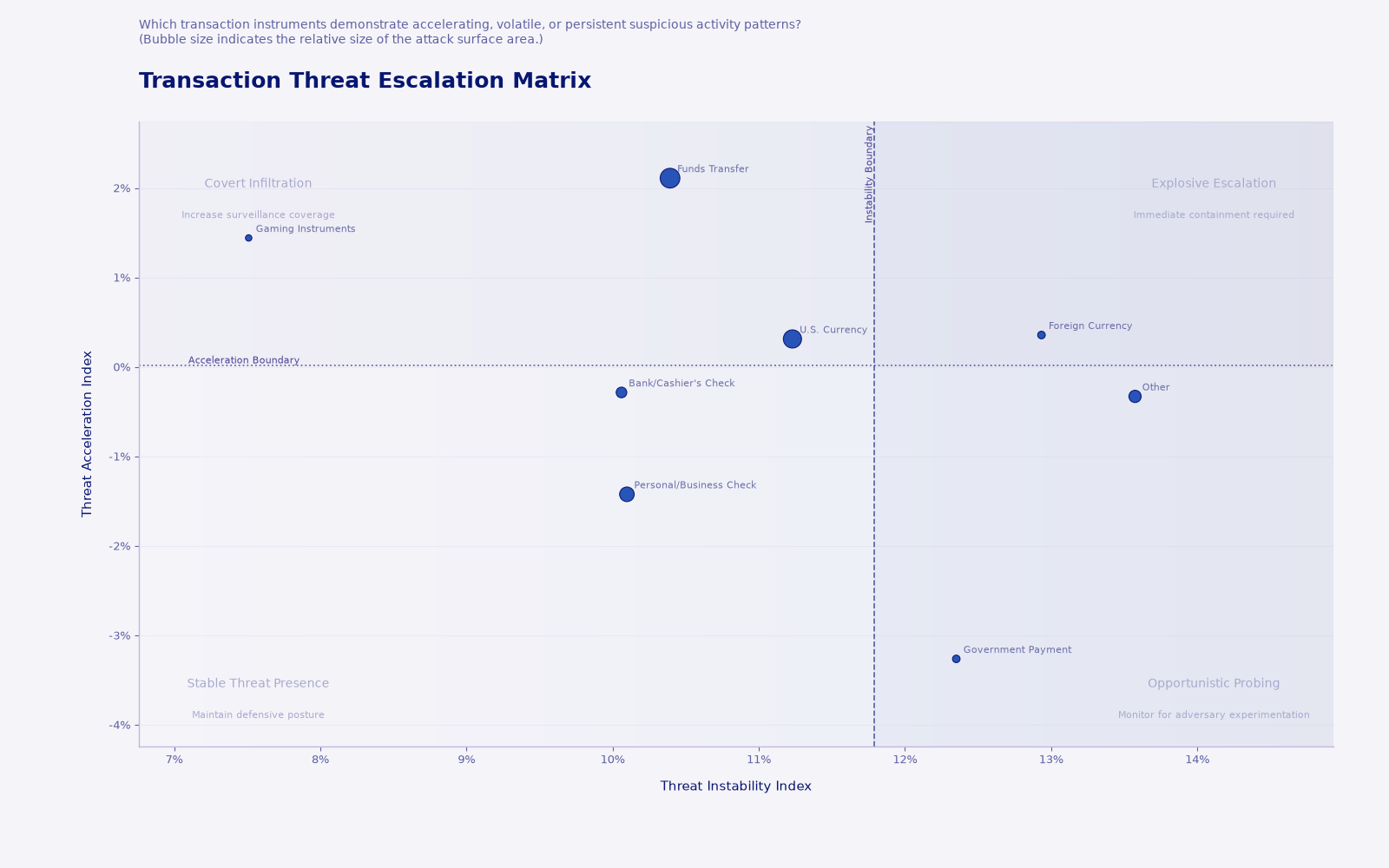
To address this problem, I have introduced what will become a core analytical framework within AQFM moving forward. The Threat Escalation Matrix. The Threat Escalation Matrix classifies fraud environments according to two behavioral dimensions.
The first dimension measures directional growth in fraud activity over time. Within AQFM, this is defined as the Threat Acceleration Index.
The second dimension measures behavioral instability through month-to-month variation in adversarial activity. Within AQFM, this is defined as the Threat Instability Index.
Together, these dimensions allow fraud environments to be classified not according to historical damage, but according to adversarial behavioral state.
Fraud losses are lagging indicators.
Behavioral evolution is a leading indicator.
The chart represents twelve months of aggregated fraud data collected across multiple financial industries. Each point represents a transaction environment. Bubble size represents relative attack surface.
The objective is not simply measuring fraud prevalence.
The objective is identifying where adversarial pressure is accumulating before operational damage fully materializes.
The resulting fraud environment reveals several important observations. While the Matrix boundaries are governed by strict mathematical thresholds, the final Confidence Level represents a holistic intelligence synthesis. It bridges hard statistical proximity to boundaries with qualitative environmental factors—mirroring standard sovereign intelligence protocols.
Check Fraud
Confidence Level: High
Check fraud currently occupies what AQFM classifies as a Stable Threat Presence environment. Aggregate fraud growth has turned negative on a trailing twelve-month basis. Behavioral instability remains below ecosystem-wide averages.
Despite continued institutional focus on check fraud, the broader adversarial environment is no longer exhibiting systemic escalation.
This creates an important operational implication. Institutions currently experiencing worsening check fraud conditions should avoid assuming ecosystem-wide threat expansion.
The broader ecosystem is contracting.
If localized exposure is increasing while the surrounding environment is stabilizing, the more likely explanation is internal defensive weakness rather than expanding adversarial pressure.
AQFM asserts a potential and specific explanation: Defensive systems may be suppressing low-complexity fraud attempts while allowing increasingly sophisticated attacks to bypass controls entirely.
This creates localized deterioration despite macro-level contraction.
The recommended posture remains unchanged. Maintain defensive posture. Current behavioral conditions do not suggest active escalation.
Funds Transfer Fraud
Confidence Level: High
Funds transfer fraud currently occupies what AQFM classifies as a Covert Infiltration environment. This classification is operationally significant. Behavioral instability remains relatively low. Adversaries are not experimenting aggressively. Attack patterns remain highly repeatable.
At the same time, aggregate fraud growth remains among the fastest accelerating categories across the observed fraud environment.
This combination suggests adversaries have already identified operationally successful attack pathways.
Experimentation has largely ended. Scaling has begun.
This is one of the most dangerous fraud environments institutions can encounter because the absence of volatility often creates the illusion of stability.
The opposite is true. Stable attack patterns frequently indicate adversarial maturity. AQFM recommends immediate telemetry expansion under conditions of covert infiltration.
Organizations should aggressively improve adversarial visibility through enhanced monitoring, anomaly detection systems, and expanded transaction surveillance before adversarial scale compounds further.
Increase defensive intelligence coverage immediately.
Foreign Currency Fraud
Confidence Level: Medium
Foreign currency fraud currently occupies the Explosive Escalation environment.
This represents the highest-risk operational state currently observed within the matrix.
Two simultaneous conditions are present.
Threat growth remains positive. Behavioral instability remains elevated.
Under AQFM asserts that this behavioral combination describes adversaries that are actively experimenting while simultaneously expanding operational scale.
This is a highly dangerous environment.
Unlike covert infiltration environments where attack strategies have stabilized, explosive escalation environments indicate adversaries are still discovering successful monetization pathways. Successful experimentation accelerates future threat growth. Unchecked escalation compounds rapidly.
AQFM doctrine treats explosive escalation environments as immediate containment problems.
The operational objective is straightforward.
Reduce adversarial access.
Disrupt monetization pathways.
Increase friction aggressively.
Immediate containment required.
Government Payment Fraud
Confidence Level: High
Government payment fraud currently occupies an Opportunistic Probing environment.
Aggregate fraud growth has contracted significantly. Recent federal anti-fraud interventions have materially reduced successful government payment fraud activity across the observed environment.
Behavioral instability remains elevated.
This combination suggests adversaries are losing existing attack pathways while continuing aggressive experimentation in search of replacement vulnerabilities.
Importantly, declining fraud losses should not be interpreted as declining adversarial intent.
The attack surface is weakening.
Adversarial adaptation continues.
AQFM treats opportunistic probing environments differently than escalating environments. Immediate containment is unnecessary. Observation becomes the priority. Organizations should expect adversaries to continue iterating until replacement attack vectors emerge.
Monitor aggressively for environmental adaptation.
Leave a Reply